REPORT : ALOK SEMWAL
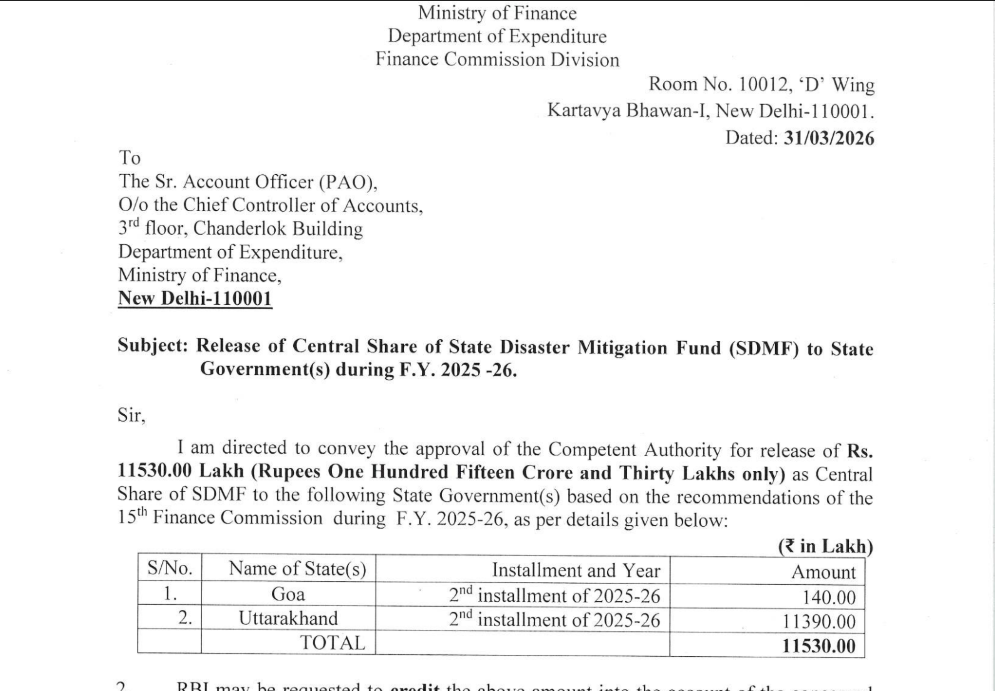
Dehradun. If there is one state in India that understands the true cost of a bad monsoon, it is Uttarakhand. Landslides that bury roads overnight, rivers that burst their banks without notice, cloudbursts that flatten entire hillsides in minutes — this is not the exception here, it is the annual reality. Keeping that in mind, the central government has approved Rs 113.90 crore for the state as the second instalment of the State Disaster Mitigation Fund (SDMF) for 2025-26. The Expenditure Department of the Union Finance Ministry cleared the release through its Finance Commission Division, and the money will land directly in the state government’s account through the Reserve Bank of India.
What Is This Fund and Where Does It Come From
This is not emergency relief money handed out after the damage is done. The SDMF is a structured fund built on the recommendations of the 15th Finance Commission, designed specifically to help states prepare for disasters before they strike — not just scramble after them. The idea is to build systems, strengthen infrastructure and improve response capacity so that when nature does what it inevitably does in the Himalayas, the human cost is not as devastating as it has been in the past.
Goa was also part of this release, receiving Rs 1.40 crore, bringing the total disbursement across both states to Rs 115.30 crore in a single go.
Conditions Are Clear — and Non-Negotiable
The Home Ministry has drawn a firm line around how this money can be used. It is earmarked exclusively for disaster mitigation work at the state level and cannot be redirected elsewhere regardless of circumstances. Beyond that, the state has just 15 days from the date of receipt to deposit both the central and state shares under the designated public account head. Fall behind on that deadline and interest kicks in automatically under Reserve Bank of India rules — a deliberate pressure valve to make sure funds move quickly rather than gathering dust in an account somewhere.
Election Commission Gives the Nod, But Sets Ground Rules
Since the Model Code of Conduct is currently in force, the Election Commission was consulted before the release. It cleared the disbursement without objection, but drew a clear boundary — this assistance is not to be used as political currency. No publicity, no announcements dressed up as government achievement, no fresh works to be launched while the code remains active. The money flows, but the optics stay neutral.
Dhami Calls It a Boost to the State’s Resilience
Chief Minister Pushkar Singh Dhami acknowledged the central assistance and said the funds would go a long way in making Uttarakhand’s disaster management machinery more robust. In his view, the state’s ability to face natural calamities head-on will be considerably stronger once these resources are put to work on the ground.
That last point matters more than it might seem on paper. Uttarakhand does not just deal with floods and landslides as isolated events — they are woven into the fabric of life here, particularly for communities tucked away in the higher reaches where help takes time to arrive and damage is often irreversible. Every rupee spent on preparation rather than repair is a rupee that potentially saves a life, keeps a road open or holds a village together through another brutal monsoon. In that sense, this Rs 113.90 crore is not just a budget line — it is a statement of intent about how seriously the centre is treating one of its most geographically vulnerable states.