Report: Alok Semwal
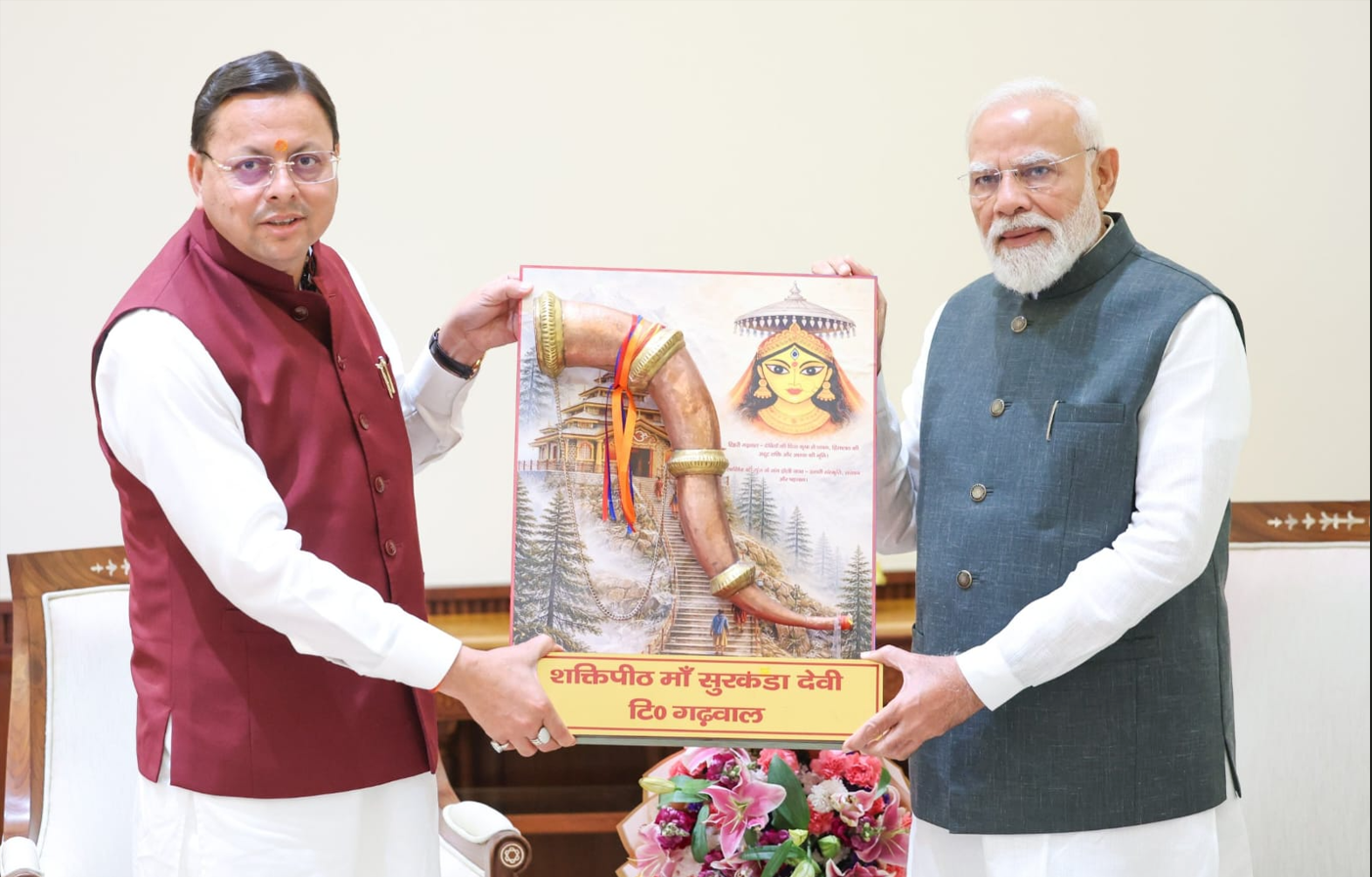
When Uttarakhand Chief Minister Pushkar Singh Dhami walked into Prime Minister Narendra Modi’s office in New Delhi, he carried something no briefcase could hold — the soul of Devbhoomi itself. The meeting, warm and unhurried, was as much about culture and connection as it was about governance and policy.
A Festival Greeting, A Sacred Gift
With Ramnavami just around the corner, CM Dhami opened the meeting on a devotional note, conveying his wishes to the Prime Minister for the auspicious occasion. But it was the gift he placed before PM Modi that truly set the tone for everything that followed.
A replica of Maa Surkanda Devi — the presiding deity of one of Uttarakhand’s most sacred Shakti Peethas, nestled high in the Tehri Garhwal hills — passed from the Chief Minister’s hands to the Prime Minister’s. For those who know Devbhoomi, this was no ordinary gesture. Maa Surkanda is not just a temple; she is the living faith of millions who climb those steep mountain paths year after year, in rain, cold and scorching sun alike. Carrying her likeness to the capital was CM Dhami’s way of saying — wherever he goes, the mountains come with him.
The Taste and Texture of the Hills
The gifts that followed were quieter in appearance but rich in meaning — each one a small window into the Uttarakhand that rarely makes headlines.
Badri Cow Ghee — Pressed from the milk of one of India’s rarest indigenous breeds, this ghee is not something you find on a supermarket shelf. The Badri cow roams the high-altitude pastures of the Himalayas, grazing on wild herbs that give her milk an almost medicinal quality. The state government has been fighting a quiet but determined battle to protect this breed from extinction. To gift its ghee was to say — this is what we are working to save, and this is why it matters.
Rajma — If there is one thing every Uttarakhand household swears by, it is the rajma from the mountains. Grown in the cold lap of the Himalayas, it has a depth of flavour and a tenderness that flatland varieties simply cannot replicate. A handful of these beans holds within it the patience of a farmer, the bite of mountain air and the warmth of a wood-fire kitchen.
Wild Mountain Honey — Harvested from hives tucked into forests where chemicals have never reached, this honey is as pure as the streams that run through those same hills. Every spoonful is the distilled effort of local beekeepers and the untouched wildness of Uttarakhand’s forest floors — something increasingly rare in today’s world.
More Than a Courtesy Call
Beyond the warmth and the gifts, the meeting had substance. CM Dhami took the opportunity to walk PM Modi through the state’s ongoing development agenda — the infrastructure being built, the tourist circuits taking shape, the connectivity projects linking remote villages to the mainstream, and the employment initiatives giving Uttarakhand’s youth a reason to stay home rather than migrate.
At a time when the state is pushing hard on multiple fronts, keeping New Delhi closely in the loop is not just protocol — it is strategy. Continued central support remains the backbone of many of Uttarakhand’s most ambitious plans, and Dhami made sure that conversation stayed alive.
There was a quiet dignity to this Delhi visit that set it apart. CM Dhami did not arrive with a list of demands or a stack of files alone — he arrived as a representative of a land that has always expressed itself through faith, nature and simplicity. The ghee, the rajma, the honey, the goddess — together they painted a portrait of Uttarakhand that no press release ever could.
Some places speak loudest when they let their mountains do the talking.