Dehradun | Report: Alok Semwal
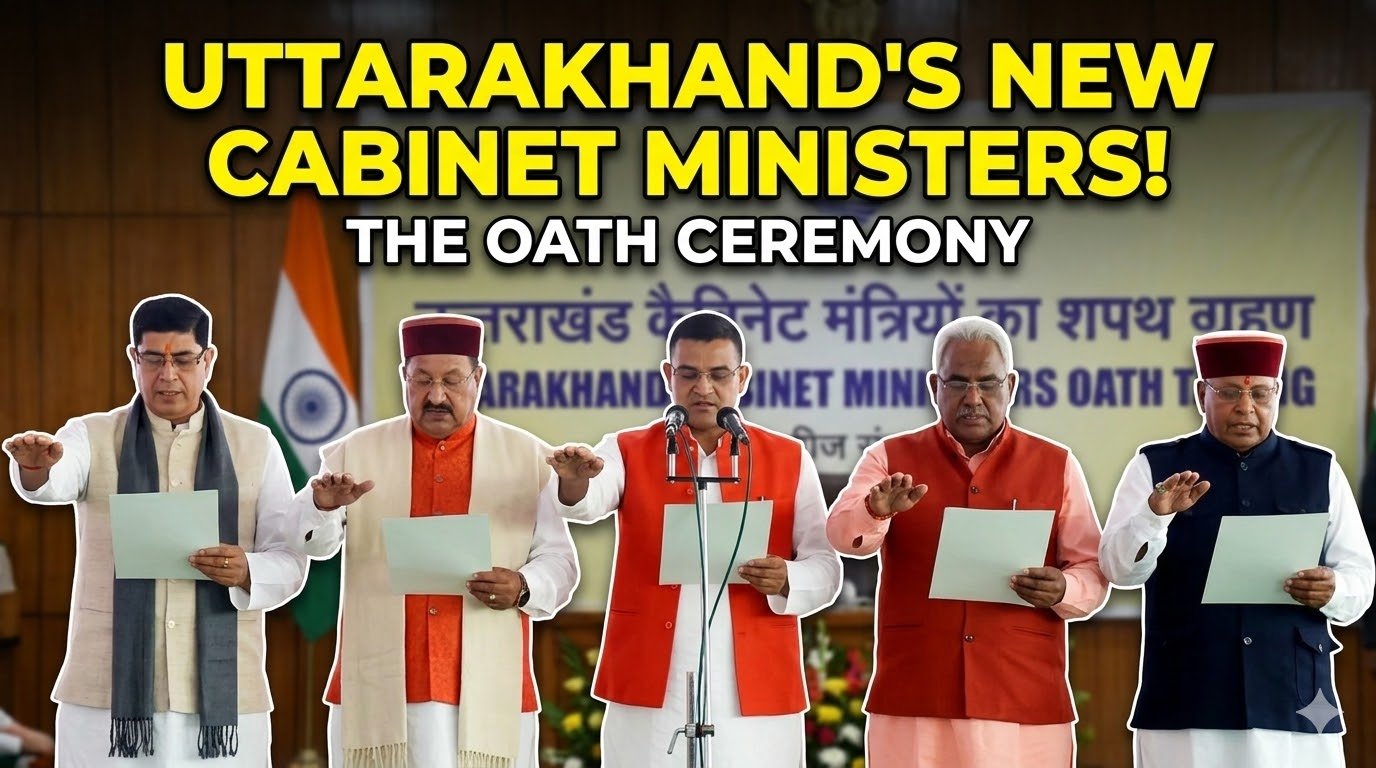
Friday morning at Lok Bhawan was different from the usual government routine. The cameras were set up, chairs arranged in careful rows, and for once, the speculation that had dragged on through two full years of Uttarakhand politics was about to be put to rest. Governor Lieutenant General Gurmit Singh swore in five MLAs as Cabinet Ministers, and just like that, Chief Minister Pushkar Singh Dhami finally has a full team around him. The number of ministers in his government now stands at 12.
The five who took the oath — Madan Kaushik from Haridwar, Khajan Das from Dehradun’s Rajpur Road, Bharat Choudhary from Rudraprayag, Ram Singh Kaira from Bhimtal, and Pradeep Batra from Roorkee — are not new names in Uttarakhand politics. Each of them has waited, worked, and watched from the sidelines long enough. Their time has come.
A Cabinet That Was Never Quite Full
To understand what happened Friday, you have to go back to 2022. When the BJP returned to power in Uttarakhand, it formed the government without filling all cabinet seats — three posts were left vacant right from the beginning. Then in April 2023, Cabinet Minister Chandan Ram Das passed away, taking the vacant count to four. In 2025, Cabinet Minister Prem Chandra Aggarwal made a controversial public statement that left him with no option but to resign, and the number of empty chairs reached five.
For nearly three years, the Dhami government ran with more than a third of its cabinet unfilled. Expansion talks would heat up every few months, names would circulate, dates would be whispered — and then nothing. Friday finally broke that pattern.
The Five Ministers and the Roads That Brought Them Here
Madan Kaushik — Five Elections, Five Wins, One City
If there is one politician in Uttarakhand who needed no introduction going into this cabinet, it is Madan Kaushik. Since 2002 — the very year the state was young and still finding its feet — Kaushik has won from Haridwar without a single interruption. Five consecutive victories from the same seat, in a city that is neither small nor predictable, is the kind of record that speaks for itself.
He did not arrive at this point overnight. He started as BJP District General Secretary, then became District President. His first stint as minister came between 2007 and 2012. During Trivendra Singh Rawat’s tenure, he held the Urban Development portfolio and doubled up as the government’s spokesperson — a combination that put him at the centre of both policy and politics. The party made him Uttarakhand BJP State President in March 2021, a role in which he led the organisation into the 2022 election campaign.
When the Dhami cabinet was formed after that election, his name was the first one everyone mentioned. And then, somehow, the expansion never came. He waited through 2023, through 2024, through 2025 — and on a Friday morning in March 2026, the wait finally ended.
Khajan Das — Winning Big on a Seat Where Winning Is Never Easy
Rajpur Road in Dehradun sounds straightforward on paper — a reserved constituency in the heart of the state capital. But reserved seats in affluent, urban areas carry their own complications. The voter is educated, has options, and does not cast ballots out of habit alone. Khajan Das has won here twice and the second time around, in 2022, he beat Congress’s Raj Kumar by over 11,000 votes. That is not a squeaker. That is a statement.
His elevation to the cabinet fits neatly into BJP’s larger approach of ensuring that Dalit representation in government is not tokenism but a genuine seat at the table. Whether that promise translates into policy will be watched closely.
Bharat Choudhary — The Long Game Pays Off After 37 Years
Some political careers are built on connections. Bharat Singh Choudhary’s was built on something slower and more durable — time. He began as a gram pradhan in 1988, back when Rudraprayag was part of undivided Uttar Pradesh and the idea of a separate Uttarakhand was still a movement, not a reality. From that village-level beginning, he has climbed steadily, winning twice from Rudraprayag assembly seat.
His strength is not the kind that shows up in press conferences. It lives in the villages of his constituency — in the roads people use, the water they drink, the problems they bring to his door. With Kedarnath drawing national attention and development money, Choudhary now has both the platform and the responsibility to show what three-and-a-half decades of grassroots politics actually delivers.
Ram Singh Kaira — The MLA Who Always Said What Bhimtal Needed Heard
In the assembly, Ram Singh Kaira was never one to sit quietly. Whether it was demanding action against man-eating leopards terrorising villages around Bhimtal, pushing for long-overdue road work, or raising the question of restoring the district’s temples and lakes — he brought his constituency’s problems to the floor consistently and without hesitation.
That kind of persistent representation matters, and now he gets a bigger stage to act on it. For the BJP, Kaira’s induction also carries a strategic weight — Kumaon is a region the party cannot afford to take for granted in 2027, and having a minister from Nainital district sends a message that the region is not being overlooked.
Pradeep Batra — Roorkee Has Sent a Practical Man to a Practical Job
Pradeep Batra comes from a business background, holds a postgraduate degree, and has won from Roorkee in 2017 and again in 2022. Roorkee is the kind of constituency that rewards results over rhetoric — it has IIT Roorkee, a significant industrial base, and a voter profile that is urban enough to be demanding. Two consecutive wins suggest Batra has found the right balance.
His swearing-in also means that Haridwar district — already the most politically consequential plains district in Uttarakhand — now holds two seats in the new cabinet. Kaushik from Haridwar city and Batra from Roorkee. That is not a coincidence. That is a calculation.
2027 Is Closer Than It Looks
Nobody in this government is pretending that Friday’s ceremony was purely about administration. The election is roughly eighteen months away, and every decision made between now and then will be read through that lens — including this one.
The regional spread of the five new ministers covers real ground. Two from the Haridwar plains, one from Kumaon, one from Garhwal’s hill belt, one from the capital. The balance between Garhwal and Kumaon, between plains and mountains, is not accidental. These are the fault lines along which Uttarakhand elections are often won and lost.
The social calculus is similarly deliberate. A Dalit minister in Dehradun, a dominant-community leader commanding Haridwar’s plains electorate, a mountain politician with deep rural roots — assembled together, they represent a coalition the BJP will need to hold together in 2027.
Then there is the matter of internal party health. When capable, loyal legislators sit outside the cabinet for years, the frustration is real even when it stays unspoken. These five men kept working — managing their constituencies, keeping local party units functional, showing up when they were needed. Bringing them in now rewards that loyalty and gives them one and a half years to prove their worth in government before the next election cycle begins.
But none of this means the job is done. Eighteen months is genuinely not much time to make a department your own, push projects to completion, and build a record that voters will remember on polling day. The ministers who move fast, focus sharply, and deliver something tangible in their constituencies will strengthen the BJP’s hand going into 2027. Those who treat the posting as a finishing line rather than a starting point will find that Uttarakhand’s voters have a long memory.
The oath has been taken. The clock, as of Friday morning, is already running.