Dehradun | Alok Semwal
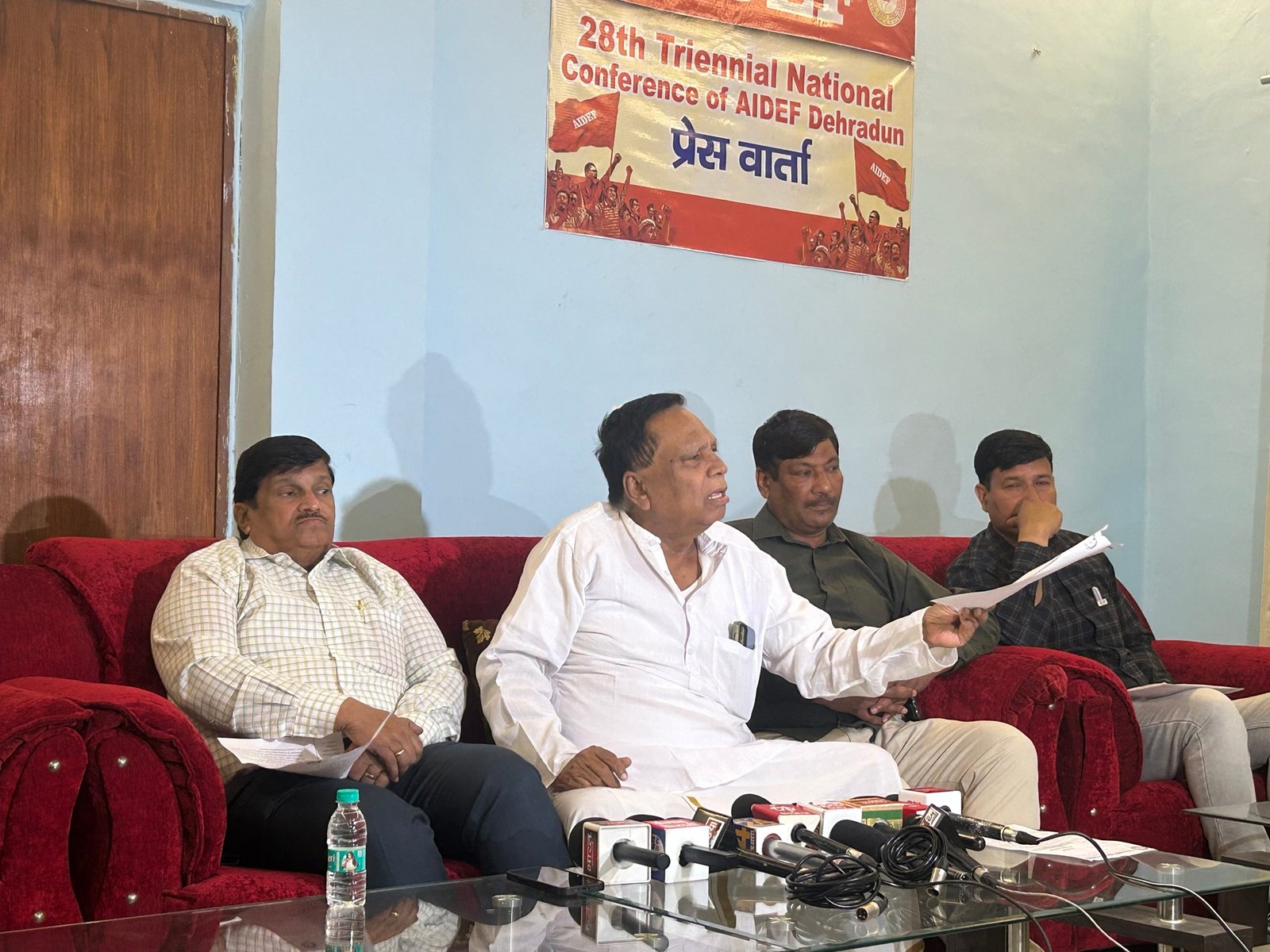
Dehradun is set to become the center of India’s defense labor movement this week as the All India Defense Employees Federation gathers for its 28th National Conference. From May 7 to 9, 2026, roughly 500 delegates from every corner of the country will fill the Uttarakhand capital — bringing with them years of frustration, unmet promises, and a sharply worded agenda for the government.
Seven Decades and Still Fighting
AIDEF was not built overnight. Since its founding in 1953, the Federation has grown into one of the most significant labor bodies in the country’s defense sector, speaking for nearly three lakh civilian workers employed across 41 Ordnance Factories, DRDO, MES, EME, AOC, DGKUA, DGQA, and establishments under the Army, Navy, and Air Force. On May 24, 2026, it will step into its 74th year — and if this week’s conference is any indication, it intends to do so with its fists raised.
This year, the hosting duties fall to AIDEF unions rooted in Dehradun’s own defense establishments — a point of quiet pride for the local workforce.
The Corporatization Question
No issue dominates the agenda quite like the corporatization of Ordnance Factories — a decision the Federation has never accepted and refuses to let die.
AIDEF is demanding a full rollback. It wants the government to dismantle what was done and hand the 41 factories back their original identity under the Ordnance Factory Board. Beyond that, the Federation is holding the government to its own word. In a petition before the Madras High Court, government representatives gave assurances that civilian defense workers would retain their Central Government employee status until retirement. AIDEF wants those assurances put in writing — through a formal Ministry of Defense notification, not verbal commitments that fade with time.
No to Contracts, Yes to Permanence
The Federation’s opposition to outsourcing and contractual employment is neither new nor softening. If anything, the language is sharper this time around. AIDEF wants a complete halt to outsourcing, privatization, fixed-term hiring, and contract-based employment across all defense establishments.
Equally important is the fate of workers already trapped in temporary arrangements. The Federation is pushing for the regularization of all casual, contractual, and fixed-term employees — and for every vacant post to be filled without further delay.
There is also a human dimension to this demand that often gets buried in policy language. Compassionate appointments — jobs given to the families of deceased employees — have been quietly restricted. AIDEF calls this illegal and is demanding that dependents of workers who died in service at Ordnance Factories and Army units be given their rightful place in the workforce.
The Pension Battle
The push to restore the Old Pension Scheme is more than a financial demand — for many workers, it is a matter of dignity in old age. AIDEF wants contributory schemes like NPS and UPS scrapped entirely, and OPS reinstated as the standard for all defense civilian employees.
The Federation is also tired of watching court victories gather dust. It is demanding that every judicial ruling in favor of employees be implemented in full — and that the government stop dragging its feet through prolonged, unnecessary litigation.
Expectations from the 8th Pay Commission
When the 8th Central Pay Commission begins its work, AIDEF wants a seat at the table — and it is arriving with specific numbers. The Federation is pushing for a minimum basic pay of ₹69,000 and a fitment factor of 3.833. It also wants guarantees of at least five promotions over a career, meaningful pension revision, and the restoration of pension commutation rights after 11 years.
Crucially, AIDEF wants to be heard independently before the Commission — not just as part of a larger collective — while also participating jointly through the National Council under the JCM framework.
Challenging the Labor Code Overhaul
The government’s consolidation of labor laws into four broad codes has drawn sharp criticism from AIDEF. The Federation wants these codes repealed. It is particularly opposed to provisions that push defense research activities outside the legal definition of “industry” — a classification that strips workers of protections they have held for decades.
The Federation is also pressing for industrial relations forums, including the JCM, to function meaningfully and consistently — pointing to the Railways as a model worth following.
A Declaration in the Making
Federation President S. N. Pathak and General Secretary C. Sreekumar have made clear that this conference will not simply pass resolutions and adjourn. The three days of deliberation will culminate in the Dehradun Declaration — a formal statement that reflects where the defense labor movement stands today and where it intends to go.
The working class, they say, is under pressure from multiple directions. The Declaration will name those pressures plainly. And it will lay out a roadmap of campaigns, protests, and organized action that AIDEF’s three lakh members can rally behind in the months ahead.