Dehradun | Report: Alok Semwal
If you run a hotel in Rishikesh, a dhaba on the Kedarnath route, or a factory on the outskirts of Haridwar, the past few months have been a constant battle — chasing cylinders, managing shortages, watching business slow down because the gas simply was not there. The state government has finally acknowledged that the old system was not working, and has replaced it with something built for the reality on the ground.
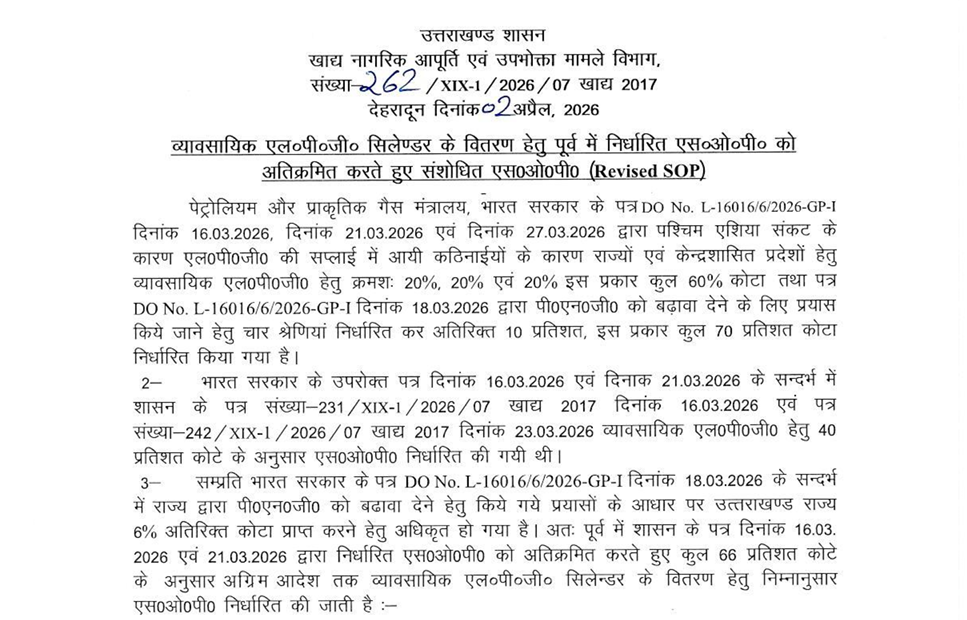
Secretary, Food and Civil Supplies, Anand Swaroop has issued a revised Standard Operating Procedure for commercial LPG distribution across Uttarakhand. Under the new arrangement, the state’s total quota has been pegged at 66 percent — a significant jump from the 40 percent it was sitting at before.
The numbers behind this jump tell an interesting story. The central government had already stepped in at some point with an additional 20 percent, but that alone was not enough to bridge the gap. The remaining 6 percent came through more recently, partly as recognition of the state’s work in expanding Piped Natural Gas coverage. Put it all together and the state now has 26 percentage points more to work with than it did under the old framework.
The Problem the Old SOP Could Not Solve
Uttarakhand is not an ordinary state when it comes to gas demand. Every spring, millions of pilgrims start moving toward Yamunotri, Gangotri, Kedarnath and Badrinath. The hotels fill up, the dhabas along the mountain roads run through the night, and the towns along the yatra corridor come alive in a way they are not for the rest of the year. Layer on top of that the regular industrial demand from Haridwar and Udham Singh Nagar, and the healthcare system’s own requirements, and you have a situation where every category of user is competing for the same limited supply.
The old SOP, designed around a 40 percent quota, was simply not calibrated for this level of demand. Secretary Swaroop was direct about what the new system is meant to fix — fair distribution, clear priorities, and no room for one sector to crowd out another. District Magistrates across the state will now be kept updated on supply figures, and oil and gas marketing companies will deliver according to their respective market share. The arrangement holds until the government decides otherwise.
The Daily Breakdown — 6,310 Cylinders, Every Single Day
The revised SOP has assigned a fixed number of cylinders to each type of consumer, and the math adds up to 6,310 cylinders distributed every day across the state.
Restaurants and dhabas sit at the top of the list with 2,000 cylinders a day — 32 percent of the total pie. That reflects the reality that these establishments are the backbone of food service along every major road and pilgrimage route in the state. Hotels and resorts come next at 1,500 cylinders, or 24 percent, keeping the tourism and hospitality sector supplied through its busiest months.
Hospitals, pharmaceutical units, automobile workshops, textile mills, chemical plants and other priority industries together get 1,250 cylinders — 20 percent of the daily total. Wedding functions have a dedicated pool of 660 cylinders at 10 percent. Government guesthouses get 300 cylinders at 5 percent. Dairy units, food processing facilities, paying guest hostels, homestays and self-help group establishments each receive 200 cylinders, accounting for 3 percent apiece.
Dehradun on Top, Every District Gets Its Share
Allocating cylinders evenly across thirteen districts of wildly different sizes and populations is never straightforward. The government has gone by the number of active gas connections and actual local demand rather than simply dividing things equally.
Dehradun, as the state’s largest urban centre, leads with 31 percent. Haridwar and Nainital follow at 13 percent each. Udham Singh Nagar gets 9 percent, Chamoli 6 percent and Rudraprayag 5 percent. Tehri, Pauri, Uttarkashi and Almora have each been given 4 percent. Pithoragarh gets 3 percent, and Bageshwar and Champawat bring up the rear at 2 percent each.
Getting Gas for a Wedding Just Got More Formal
Weddings in Uttarakhand, like everywhere in India, can be large affairs with serious cooking requirements. The new SOP acknowledges this, but also puts guardrails in place to prevent the wedding quota from being misused as a backdoor into the commercial supply chain.
The cap is firm — two commercial cylinders per wedding function, no exceptions. To get them, the family will need to file an application with the District Magistrate or whoever has been designated for this purpose. The paperwork will be checked, approval granted, and only then will the gas distributor issue a temporary connection. Once the event is over and the permitted window closes, those cylinders go straight back into the general pool.
Of the 660 cylinders reserved for weddings statewide, Dehradun and Nainital get the largest chunk at 176 each. Haridwar and Udham Singh Nagar have been allocated 64 cylinders apiece. The remaining districts will receive somewhere between 18 and 24 cylinders based on their typical demand.
On the industrial side, Dehradun, Haridwar and Udham Singh Nagar have each been given 380 cylinders from the industrial pool of 1,250. Nainital and Tehri get 20 each, and Pauri has been assigned 70.